QHSE
QHSE — Our commitment to safe, compliant and well-controlled work
At SFP GROUPE, Quality, Hygiene, Health, Safety and environmental protection are built into every stage of our interventions: preparation, mobilisation, execution, inspection, acceptance and lessons learned. Our priority is to protect workers, facilities, communities and the environment, while ensuring the technical compliance, traceability and reliability of the work performed.
Our QHSE commitment
SFP GROUPE is committed to:
- Prevent injuries, incidents, occupational illnesses and property damage
- Identify and control risks before the start of each activity
- Comply with legal, regulatory and contractual requirements, as well as those specific to client sites
- Provide protective equipment suited to the work
- Verify the skills and qualifications of personnel
- Ensure the compliance and traceability of works
- Reduce waste, emissions, spills and environmental impacts
- Report, analyse and address incidents, anomalies and hazardous situations
- Continuously improve work methods and QHSE performance
- Recognise every worker's right and responsibility to stop a dangerous operation
Operational control
Prevent, control and improve
Open each panel to view the measures applied depending on the nature of the work.
Planning and risk analysis
No intervention may begin without preparation proportionate to the level of risk. Depending on the nature of the work, this preparation includes:
- Technical visit and precise definition of scope
- Hazard identification and risk assessment
- Job safety analysis
- Development of the work procedure
- Definition of responsibilities and supervision resources
- Verification of skills, qualifications and authorisations
- Inspection of equipment, tools, machinery and lifting accessories
- Determination of required PPE and collective protections
- Coordination with other companies present on site
- Identification of emergency measures and rescue resources
- Validation of work permits required by the client
A safety talk is held before starting and whenever a change may alter the conditions of execution.
Quality and control of works
Our quality approach aims to deliver works that comply with drawings, technical specifications, applicable codes and client requirements. It relies in particular on:
- Review of drawings and contractual documents before execution
- Identification and traceability of materials
- Inspection of the receipt and storage of consumables
- Use of appropriate manufacturing and welding procedures
- Verification of welder and operator qualifications where required
- Monitoring of essential welding parameters
- Visual and dimensional inspections
- Control of repairs and non-conformities
- Use of non-destructive testing according to project requirements
- Protection and preservation of works before delivery
- Compilation of an end-of-works file
Depending on the contract, the acceptance file may include inspection reports, traceability sheets, test records, material certificates, dimensional surveys, photographs and as-built drawings.
Safety of welding and hot work
Welding, cutting, grinding, oxy-cutting and Arc-Air gouging operations are carried out under strict control. Applicable measures include:
- Hot work permit where required
- Prior inspection of the area
- Removal or protection of combustible materials
- Provision of appropriate fire extinguishers
- Inspection of cylinders, regulators, hoses and flashback arrestors
- Grounding and cable inspection
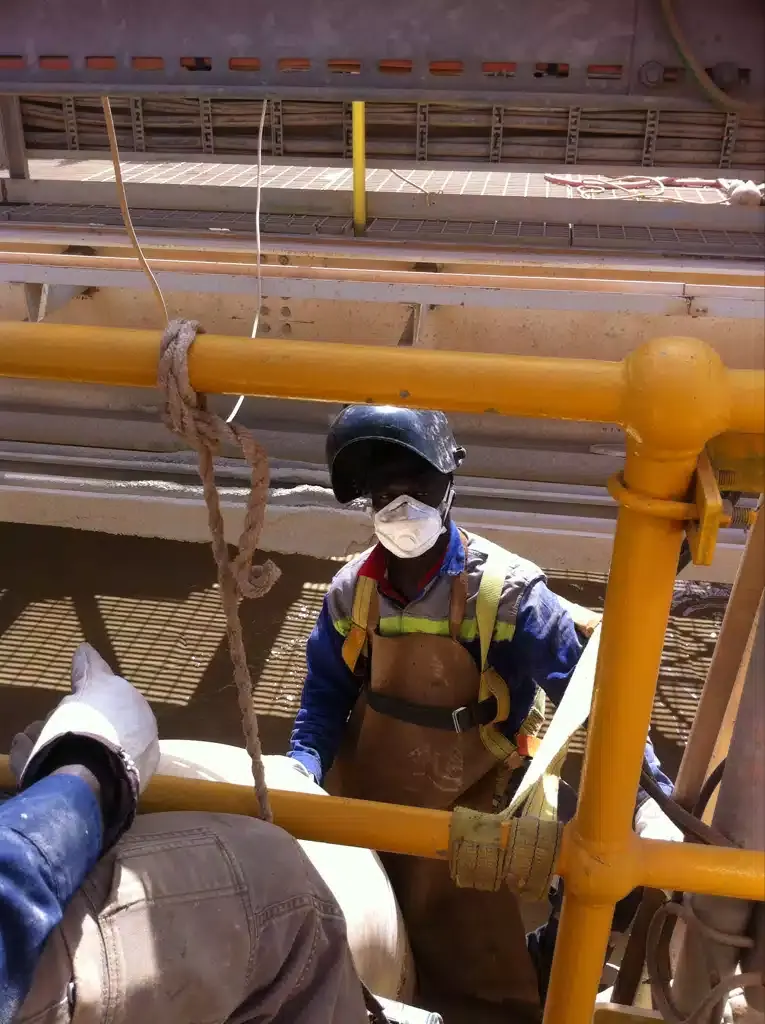
- Protection against radiation, fumes, splatter and hot particles
- Suitable ventilation or extraction
- Monitoring of the area during and after work
- Atmospheric testing when conditions require it
Work at height
Any work presenting a risk of falling is subject to appropriate measures:
- Prior assessment of access points
- Priority to collective protections
- Inspection of scaffolding and platforms
- Appropriate harnesses, lanyards and anchor points
- Verification of fall-arrest equipment
- Marking of the area below
- Recovery or rescue plan according to the risk level
- Suspension of work when weather conditions become dangerous
Confined spaces
Access to a confined space is prohibited without authorisation and suitable preventive measures. Key measures include:
- Entry permit
- Lockout of energy sources and isolation of equipment
- Atmospheric testing before and during the intervention
- Appropriate ventilation
- Permanent attendant stationed outside
- Communication means
- Limitation and control of access
- Rescue equipment
- Specific emergency plan
- Trained and medically fit personnel where required
Lockout of energy sources
Before any maintenance operation, hazardous energy sources must be identified, isolated, locked out and verified. This approach may concern:
- Electricity
- Hydraulic or pneumatic pressure
- Hot, chemical or flammable fluids
- Mechanical movements
- Gravity and suspended loads
- Thermal energy
- Automatic or remote start-ups
Equipment may only be returned to service after inspection of the area, authorised removal of lockout devices and validation by the responsible persons.
Lifting, handling and assembly
Lifting operations are planned according to the weight, geometry of the load, equipment capacity and work environment. Measures include:
- Lift assessment or lift plan depending on complexity
- Verification of crane and equipment capacities
- Inspection of slings and accessories
- Verification of ground stability
- Designation of competent persons
- Clear communication between crane operator and signaller
- Marking of the exclusion zone
- Prohibition on standing under a suspended load
- Consideration of wind, obstacles and power lines
Health, hygiene and working conditions
SFP GROUPE takes care to limit workers' exposure to risks that may affect their health. Particular attention is paid to:
- Welding fumes and gases
- Noise and vibration
- Dust and chemical products
- Heat and weather conditions
- Physical effort and manual handling
- Lighting and ventilation
- Fatigue and organisation of working time
- Cleanliness of facilities and rest areas
- Availability of drinking water and first-aid resources
Environmental protection
Every worksite must be organised to reduce its environmental footprint. Our principles include:
- Sorting, storage and controlled removal of waste
- Recovery of metal offcuts and used consumables
- Prevention of spills of oils, fuels, paints and solvents
- Use of containment trays
- Availability of spill response resources
- Control of dust, fumes and noise nuisance
- Protection of soils, water and drainage networks
- Reduction of water, energy and gas consumption
- Restoration and cleaning of areas after intervention
Emergency preparedness
Before work begins, teams are briefed on the emergency procedures applicable on site. Depending on the risks identified, arrangements may cover:
- Fire or explosion
- Injury or illness
- Fall from height
- Confined space incident
- Product spill
- Gas leak
- Lifting incident
- General evacuation
Evacuation routes, assembly points, alarm systems, fire extinguishers and first-aid kits must be known and accessible.
Reporting and lessons learned
Any incident, near-miss, hazardous situation, technical fault or non-conformity must be reported without delay. Each significant event is subject, depending on its severity, to:
- Immediate securing of the area
- A record
- A root-cause analysis
- A corrective action plan
- A responsible person and a deadline
- Verification of the effectiveness of the measures
- Sharing lessons learned with the teams
No worker shall be penalised for reporting a hazard in good faith or for stopping an activity presenting a serious risk.
Management of subcontractors and partners
Partners and subcontractors engaged by SFP GROUPE are subject to the QHSE requirements applicable to the project. Before their intervention, we verify in particular:
- Their skills and references
- The qualifications and authorisations of their personnel
- The compliance of their equipment
- Their ability to comply with site rules
- Their understanding of the prevention plan
- Their participation in site inductions and safety meetings
Performance monitoring
Our continuous improvement approach is progressively based on indicators such as:
- Number of hours worked
- Safety talks and inspections carried out
- Hazardous situations reported
- Incidents and near-misses
- Corrective actions opened and closed
- Compliance of inspected equipment
- Technical non-conformities
- Rework or repair rate
- Waste produced and recovered
- Training and qualifications completed
This data makes it possible to identify trends, improve prevention and strengthen operational control.
On the ground
Our non-negotiable rules
Our objective
A safe, compliant and reliable installation
Carry out every intervention to the expected level of quality, protect all persons concerned, and hand the client a safe, compliant, reliable and documented installation.
Safety is not an extra step in the work: it is the first condition of its success.
Request our QHSE plan
Are you preparing a worksite, a plant shutdown, a maintenance operation or a manufacturing project? Contact SFP GROUPE to receive a presentation of our QHSE approach and discuss your site's specific requirements.
Request our QHSE plan Download our QHSE plan (French)QHSE plan — version 1.0, September 2026.