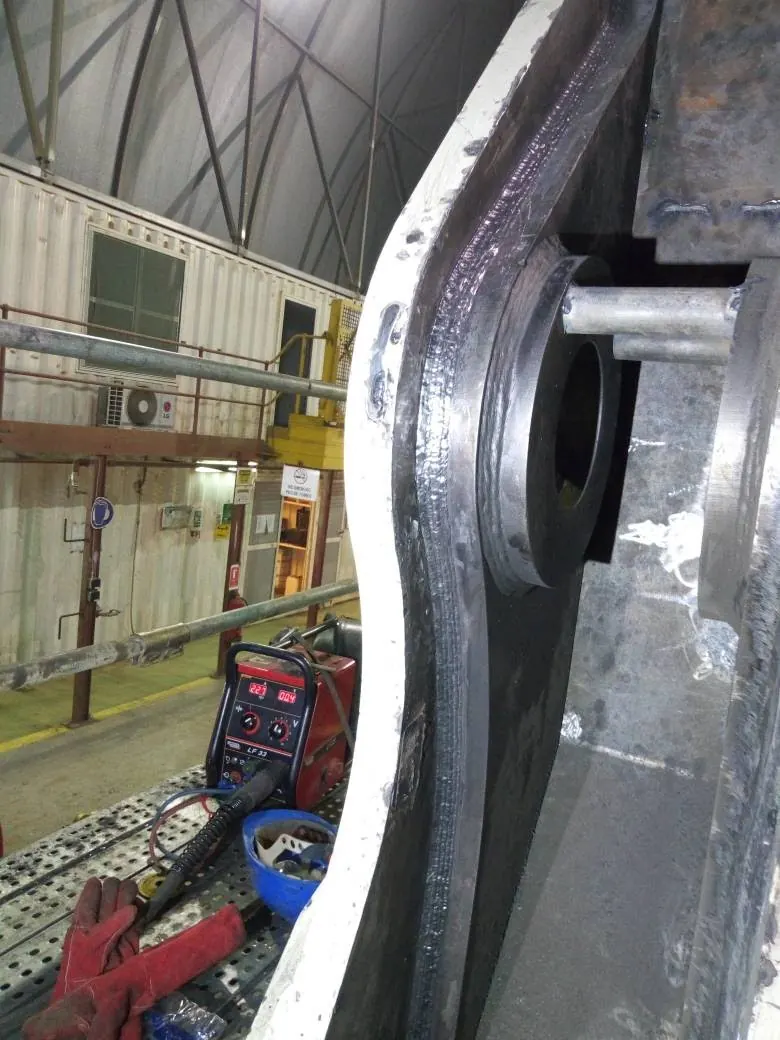
Welding trainer assisting a participant during a practical workshop exercise

Training

Professional training in welding and industrial trades

SFP GROUPE is preparing training programmes for industrial workshops and worksites: introductory, skills-improvement, refresher and technical qualification-test preparation courses. Opening will depend on confirmed resources, instructors and partnerships.

Our approach

Theory, practice and safety

The courses combine theory, demonstrations, practical exercises, inspection of assemblies and rigorous application of health and safety rules. They are designed for companies, experienced workers, beginners and young people wanting to learn an industrial trade.

Who it's for

  • • Young people wanting to learn an industrial trade
  • • Beginners seeking direction
  • • Working welders and tradespeople seeking a refresher
  • • Employees in career transition
  • • Companies wanting to train their teams

Section 1

Welding processes

Each process is covered by a dedicated module, with settings, technique, applications and quality control.

TIG — GTAW

Tungsten electrode welding under gas shielding, used for joints requiring high precision and excellent finish quality.

  • Setting up the machine and choosing parameters
  • Preparing and cleaning joints
  • Selecting tungsten and filler metal
  • Arc striking, arc maintenance and weld-pool control
  • Welding carbon steel, stainless steel and aluminium
  • Welding plates and pipework
  • Visual inspection and defect identification

MIG — GMAW

Semi-automatic welding under inert gas, mainly used for aluminium, stainless steel and certain alloys.

  • Equipment preparation and setup
  • Choice of wire electrode and gas
  • Voltage and wire-speed settings
  • Short-circuit, globular and spray transfer
  • Welding techniques for plates and structures
  • Prevention of defects and distortion

MAG — GMAW

Semi-automatic welding under active gas, widely used in metal fabrication, boilermaking and carbon-steel structures.

  • Parameter setup
  • Choice of wire and gas mixture
  • Tacking and assembly techniques
  • Welding in different positions
  • Fabrication of metal structures
  • Control of penetration and bead appearance

Stick welding — SMAW / MMA

A versatile process used in workshops, on site, in maintenance and for outdoor work.

  • Identifying and storing electrodes
  • Current setting and polarity choice
  • Arc striking and stability
  • Butt and fillet welding
  • Welding plates, sections and pipework
  • Working flat, horizontal, vertical and overhead
  • Slag removal and visual inspection

Flux-cored — FCAW

A high-productivity process suited to metal structures, heavy work and industrial environments.

  • Choosing flux-cored wire and shielding gas
  • Wire-feed and parameter setup
  • Welding with or without gas shielding depending on application
  • Multi-pass welding
  • Managing slag and spatter
  • Applications on thick structures

Oxy-acetylene — OAW

Introduction to welding, brazing, heating and related operations using an oxy-fuel flame.

  • Setting up and checking equipment
  • Flame adjustment
  • Welding thin-gauge plates
  • Brazing and heating
  • Preventing flashback
  • Safe handling of gas cylinders

Submerged arc welding — SAW

A high-productivity mechanised process, notably for long joints and heavy thicknesses.

  • Principle of welding under granular flux
  • Joint preparation and parameter setup
  • Choice of wire electrode and flux
  • Control of travel speed and penetration
  • Applications on plates and welded assemblies
  • Visual inspection and defect prevention

Oxy-fuel cutting

A thermal cutting technique for steel using an oxy-fuel flame and an oxygen jet.

  • Setting up and checking equipment
  • Flame and cutting-oxygen adjustment
  • Marking and preparing parts
  • Straight cuts, circular cuts and bevels
  • Preventing flashback
  • Cylinder and hose safety

Plasma cutting

A plasma-arc cutting technique suited to conductive metals and work requiring speed and precision.

  • Commissioning and checking equipment
  • Choice of consumables and current setting
  • Manual cutting techniques
  • Cutting steel, stainless steel and aluminium
  • Cut quality and edge finishing
  • Prevention of electrical, thermal and fume-related hazards

Section 2

Welding positions

The positions taught vary according to the participant's level and the process being practised.

Basic positions

  • Flat
  • Horizontal
  • Vertical up and down
  • Overhead

Plate positions

  • 1G
  • 2G
  • 3G
  • 4G

Pipe positions

  • 1G
  • 2G
  • 5G
  • 6G

Fillet welds

  • 1F
  • 2F
  • 3F
  • 4F

Access to advanced positions depends on the participant's level and the results obtained in preparatory exercises.

Section 3

Materials covered

  • Carbon steel
  • Stainless steel
  • Aluminium
  • Low-alloy steels
  • Plates, sections, tubes and pipework

Exercises cover these materials according to the programme chosen and the equipment available.

Section 4

Complementary modules

These modules can be taken on their own or combined with a welding pathway.

  • Workshop and site safety
  • Fire prevention and hot-work permits
  • Use of PPE
  • Reading industrial drawings
  • Reading isometric drawings
  • Welding symbols and conventions
  • Joint preparation and fit-up
  • Marking, cutting and grinding
  • Carbon-arc gouging — CAC-A: weld removal, repair preparation and industrial repairs.
  • Metallurgy applied to welding
  • Distortion, stresses and welding sequences
  • Welding defects and prevention methods
  • Visual weld inspection
  • Introduction to non-destructive testing
  • Interpreting a WPS or welding instruction
  • Equipment maintenance and checks
  • Productivity and workstation organisation
  • Boilermaking and welded fabrication
  • Industrial piping
  • Structural steel construction

Section 5

Training formats

Each pathway is built around your level, your goals and the available schedule.

Introduction

Discovering the trade and learning fundamental techniques.

Skills improvement

Improving technique and the quality of assemblies.

Refresher

Addressing gaps before taking up a new role or assignment.

Qualification preparation

Training in a given process, material and position, according to requirements set by the employer or certifying body.

In-company training

A programme tailored to the client's equipment, materials, procedures and constraints, on your site or in the workshop.

Section 6

Assessment and follow-up

Depending on the format chosen, your pathway may include the following steps.

  • Initial level assessment
  • Progressive practical exercises
  • Visual inspection of assemblies
  • Theoretical and practical assessment
  • Progress report
  • Certificate of attendance or completion

Important disclaimer

SFP GROUPE offers training courses and technical preparation. Any regulated qualification or certification is issued exclusively by an authorised certifying body or approved partner, under the applicable standard.

Enquiry

Request the programme or enrol

Tell us what you need: we will get back to you with the programme, dates, location and arrangements.

Fields marked with an asterisk are required.

SFP GROUPE offers training courses and technical preparation. Any regulated qualification or certification is issued exclusively by an authorised certifying body or approved partner, under the applicable standard.

Practical information

Frequently asked questions

Which welding processes are covered in training?

Programmes can cover TIG, MIG/MAG, stick welding (SMAW), flux-cored arc welding, oxy-acetylene welding and submerged arc welding, as well as oxy-fuel cutting, plasma cutting and carbon-arc (CAC-A) gouging.

Are the courses open to beginners?

Yes. An initial assessment guides each participant towards an introductory course, skills improvement, a refresher, or technical preparation suited to their goal.

Does an SFP course award a regulated qualification?

SFP GROUPE offers training courses and technical preparation. Any regulated qualification or certification is issued exclusively by an authorised certifying body or approved partner, under the applicable standard.

Where can the courses be held?

Depending on the programme, available equipment and group size, a future course may be held in a suitable technical space in Tivaouane or on the premises of the requesting company.